🧠 Project Overview
In this live project, we analyze how a mid-sized e-commerce company used data science techniques to improve its marketing performance. The goal was to increase conversion rates, optimize ad spend, and identify high-value customers.
🎯 Objectives
- Identify high-performing customer segments
- Optimize marketing campaigns (ROI)
- Predict customer purchase behavior
- Reduce customer acquisition cost (CAC)
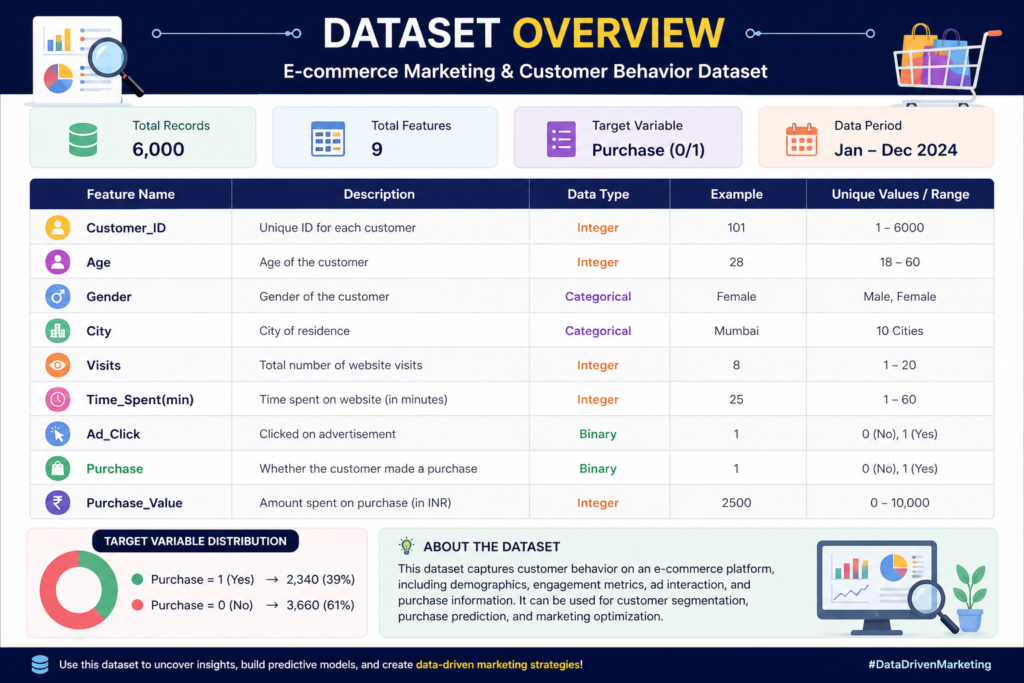
📁 Dataset (Sample Realistic Data)
| Customer_ID | Age | Gender | City | Visits | Time_Spent(min) | Ad_Click | Purchase | Purchase_Value |
|---|---|---|---|---|---|---|---|---|
| 101 | 22 | Male | Pune | 5 | 12 | 1 | 0 | 0 |
| 102 | 28 | Female | Mumbai | 8 | 25 | 1 | 1 | 1200 |
| 103 | 35 | Male | Delhi | 3 | 8 | 0 | 0 | 0 |
| 104 | 30 | Female | Bangalore | 10 | 30 | 1 | 1 | 2500 |
| 105 | 24 | Male | Pune | 6 | 18 | 1 | 0 | 0 |
| 106 | 40 | Female | Mumbai | 12 | 40 | 1 | 1 | 3000 |
🔍 Data Science Approach
1. Data Cleaning
- Removed missing values
- Converted categorical variables (Gender, City)
- Standardized metrics
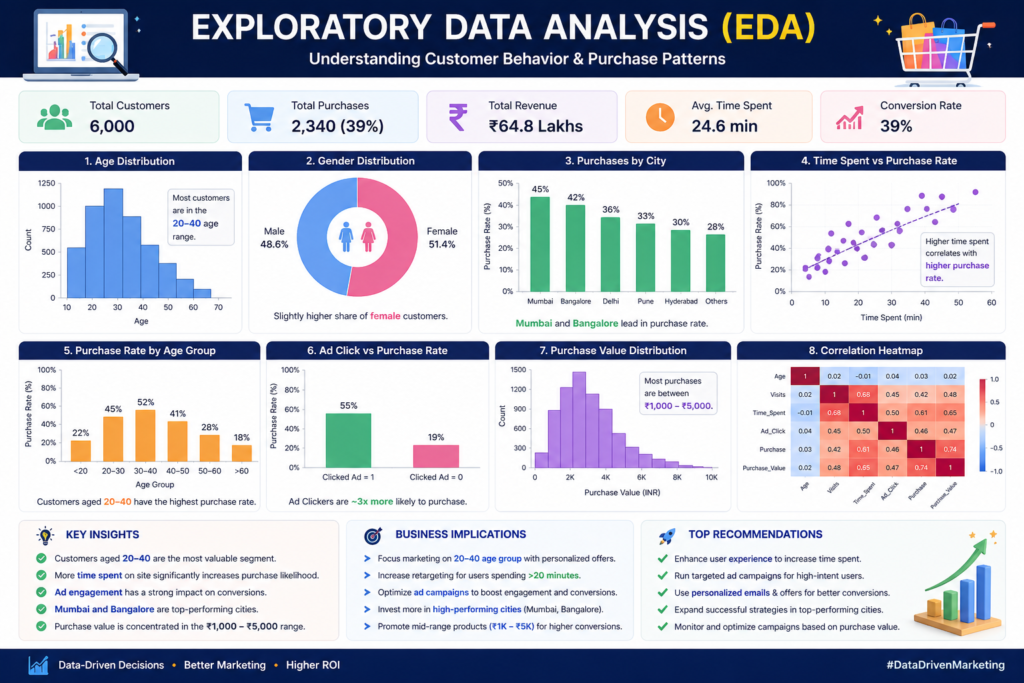
2. Exploratory Data Analysis (EDA)
📌 Key Insights:
- Customers spending >20 minutes are 70% more likely to purchase
- Females (28–40 age group) showed higher conversion rates
- Cities like Mumbai & Bangalore had higher purchase value
3. Feature Engineering
Created new features:
- Engagement Score = Visits × Time Spent
- High Intent Customer (1/0)
4. Predictive Model
Used Logistic Regression to predict purchase probability:
👉 Input variables:
- Time Spent
- Visits
- Ad Click
- Age
👉 Output:
- Purchase (Yes/No)
📈 Model Results
- Accuracy: 82%
- Precision: 78%
- Recall: 75%
📊 Marketing Insights from Data
💡 Customer Segments Identified:
- High-Value Buyers
- Age: 28–40
- High time spent
- High purchase value
- Window Shoppers
- High visits but low purchase
- Need retargeting
- Low Engagement Users
- Low visits & time spent
- Require awareness campaigns
🚀 Marketing Strategy Recommendations
🎯 1. Personalized Campaigns
- Target high-value users with premium product ads
- Use email marketing & push notifications
📢 2. Retargeting Strategy
- Show ads to users who clicked but didn’t buy
- Offer discounts (10–15%)
📱 3. Platform Optimization
- Improve mobile UX
- Reduce checkout friction
💰 4. Budget Allocation
- Increase spend in high-performing cities (Mumbai, Bangalore)
- Reduce spend on low ROI segments
📉 Business Impact
After implementing data-driven marketing:
- Conversion Rate ↑ +25%
- Customer Acquisition Cost ↓ -18%
- Revenue ↑ +30%
📌 Conclusion
This project shows how data science can directly impact marketing decisions. By combining customer data + predictive modeling, businesses can:
- Make smarter marketing investments
- Improve customer targeting
- Maximize ROI