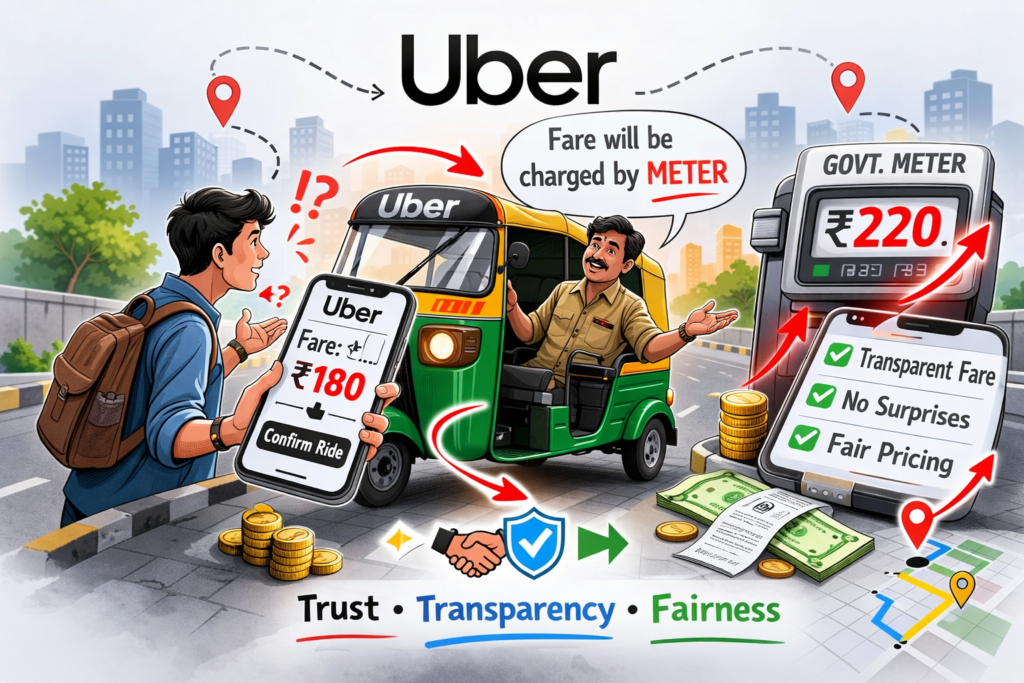
Uber Pricing in India explained: Discover why your ₹180 Uber ride becomes ₹220, the role of meter pricing, government rules, and how it impacts riders.
Understanding the Root Cause
To understand why this happens, we need to look at how ride-hailing platforms like Uber operate in India.
India is one of the largest ride-hailing markets globally, with millions of daily rides and strong competition from players like Ola. Cities such as Mumbai, Bangalore, and Pune contribute significantly to this demand.
However, unlike some global markets, pricing in India is not entirely controlled by platforms.
The Role of Government Regulations
In states like Maharashtra, transport authorities mandate that auto-rickshaw fares follow government-approved meter rates.
A typical fare structure includes:
- A base fare (around ₹23)
- A per-kilometer charge (₹15–₹18)
- Waiting charges (₹1–2 per minute)
Because of this, drivers are legally allowed—and sometimes incentivized—to follow meter pricing instead of the app’s estimate.
The Shift in Uber’s Product Model
Traditionally, Uber operated on a fixed-price model where the fare shown in the app was final.
However, for auto-rickshaws, Uber has increasingly moved toward a marketplace model:
- The platform connects riders and drivers
- Drivers may follow government meter pricing
- The app shows only an estimated range instead of a guaranteed fare
This shift is crucial—but not always clearly communicated to users.
The Core Product Problem
This creates a mismatch between user expectations and actual experience.
From a product perspective, three stakeholders are involved:
- Riders expect price certainty and transparency
- Drivers want fair compensation, especially for traffic and waiting time
- Government requires compliance with regulated fares
The conflict arises because these needs are not perfectly aligned.
Impact on User Experience
When a rider sees one price in the app but hears another during the ride, it creates confusion and distrust.
This leads to:
- Riders feeling overcharged
- Increased ride cancellations
- Poor ratings and negative reviews
Over time, even small friction points like this can significantly damage user trust.
The Business Impact
This is not just a user experience issue—it has direct financial consequences.
Let’s consider a simple estimate:
- Around 10 million rides happen daily in India
- If cancellations increase by just 2–3%, that’s 200,000–300,000 lost rides per day
- With an average commission of ₹50 per ride, Uber could lose ₹1–1.5 crore daily
Over a month, this translates to a potential loss of ₹30–45 crore.
A small change in user behavior can create a massive business impact.
Identifying the Real Problem
It is important to note that meter pricing itself is not the problem.
The real issue is lack of transparency.
When users are not clearly informed about how pricing works, they assume the app price is final. Any deviation from that expectation feels like a violation of trust.
How Uber Can Solve This
The solution lies in improving clarity rather than changing the entire pricing system.
Uber can address this in several ways:
1. Clearly Show Pricing Type Before Booking
The app should explicitly mention whether the ride is:
- Fixed fare
- Meter-based fare
This simple change can eliminate confusion at the start.
2. Allow Drivers to Choose Pricing Mode
Drivers should select their pricing method before going online.
Riders can then be matched accordingly.
This prevents disagreements during the ride.
3. Improve Fare Estimates
Using traffic and historical data, Uber can provide a more realistic price range instead of a single estimate.
This helps set correct expectations.
4. Introduce a Digital Meter in the App
Instead of relying on a physical meter, the app itself can calculate fare based on:
- Distance
- Time
- Government rules
This ensures both rider and driver see the same price in real time.
5. Add a Pre-Ride Confirmation
Before the trip starts, the app can ask:
“Do you agree to a meter-based fare?”
This removes surprises later.
6. Educate Users
A simple in-app message explaining that some rides follow government meter rules can go a long way in reducing confusion.
Final Takeaway
This situation highlights an important product lesson:
User trust depends on clarity, not just functionality.
Even if the system is technically correct, a lack of communication can make it feel broken.
By improving pricing transparency, Uber can:
- Reduce cancellations
- Improve customer satisfaction
- Recover lost revenue
Sometimes, the biggest product problems are not about building new features—but about making existing ones easier to understand.